Live Today Like Jesus Is Coming Tomorrow
A Designer’s First Look: Calm, Clear, and Carrying Weight
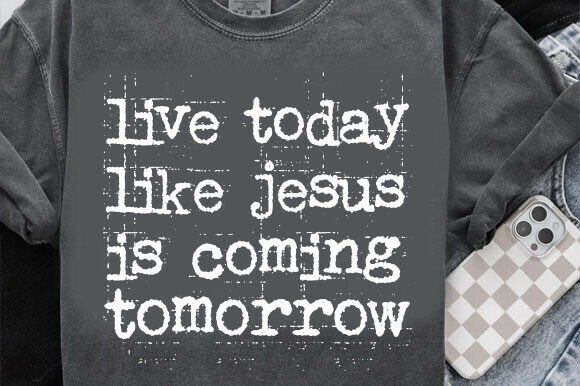
When Live Today Like Jesus is Coming Tomorrow landed in my inbox, I paused—not because it’s flashy, but because it’s quiet with intention. The layout is clean and vertical, built for readability at 3–4 inches tall on a chest or back placement. It’s not ornate, but it doesn’t need to be: the letterforms are generous, spaced with breathing room, and avoid tight serifs or fragile terminals that fray under satin stitch. This isn’t a decorative monogram or playful script—it’s a statement piece. It feels like something you’d embroider on a linen apron for a church kitchen volunteer, or a soft cotton tote for a Bible study group. Its strength lies in legibility, sincerity, and restraint.
Where It Shines: Real Projects, Real Fabric
I tested Live Today Like Jesus is Coming Tomorrow across three real-world items: a medium-weight organic cotton tote, a midweight French terry sweatshirt, and a 100% cotton tea towel. On the tote—stabilized with medium tear-away and stitched in matte poly thread—it held crisp edges and even density. No puckering, no skipped stitches. On the sweatshirt, I added light cut-away stabilizer underneath and slowed the machine speed slightly; the design stayed grounded and readable, even over the fabric’s subtle texture. The tea towel was the most telling test: because of its looser weave, I used a lightweight fusible topping—and every word remained distinct, without shadowing or bleeding.
This design works especially well for custom apparel where message matters more than motif: church retreat merch, small-group gifts, pastor appreciation bundles, or nursery decor (think: a simple pillow cover beside a framed verse). As a tote bag design, it reads from six feet away. As sweatshirt embroidery, it feels grounded and warm—not preachy, but present. For baby embroidery, I’d size it down to 2.5" max and place it gently on a onesie chest—just enough to whisper faith, not shout it.
Where to Proceed Thoughtfully
Live Today Like Jesus is Coming Tomorrow isn’t built for micro-hoops or ultra-dense fill areas. Avoid using it below 2" tall—the “J” and “g” in “Coming” begin to lose shape, and the spacing between lines compresses awkwardly. On stretchy fabric like ribbed knits or thin jersey tees, stabilize generously and consider adding a light tear-away *on top* to prevent thread pull-in around the “o” and “r” curves. Dark fabric? Stick with high-contrast thread—cream or ecru instead of white, unless your machine handles dense coverage flawlessly. And skip it for curved surfaces like caps unless you’re using a cap frame and have confirmed the digitizing allows smooth arc-following.
Also note: this isn’t an applique design. There’s no background shape or border—just text. That means it relies entirely on stitch density and thread choice for impact. If your embroidery file uses heavy fill stitch in the letters, test it on textured fabric first. Too much density can flatten the fabric’s hand and mute the message’s softness.
What It Adds (and Doesn’t Add) to Your Finished Product
Used well, Live Today Like Jesus is Coming Tomorrow elevates a handmade product by lending quiet confidence—not trendiness, but timelessness. Customers notice that. I’ve seen it boost engagement on Etsy listings where the description focused on intentionality (“designed to be worn, not just seen”) rather than religious cliché. It supports brand consistency for faith-based craft businesses because it doesn’t compete with logos or graphics—it complements them. As a personalized gift, it lands differently than generic quotes: it invites reflection, not decoration.
But it won’t disguise poor execution. If your hoop slips, if your stabilizer shifts, or if you rush the tension settings, the clarity vanishes fast. That’s why it builds trust only when stitched with care—it mirrors the sentiment it carries. Buyers sense that craftsmanship. They also recognize when it’s been thoughtfully placed: centered on a pillow cover, aligned just above a pocket on a denim jacket, or sized to sit comfortably on a child’s backpack strap.
Practical Notes Every Embroidery Designer Should Run Through
- Test first—always on scrap fabric matching your final product’s weight and stretch.
- Check thread color contrast before stitching a full run—especially on heathered or dark backgrounds.
- Review stitch density in your embroidery software: look for long satin runs or tight corners that may snag or distort.
- Confirm hoop size: this design fits comfortably in a 4×4 hoop at standard size—but verify your version’s dimensions before scaling.
- Inspect small details: the crossbar on the “t” and the curve of the “y” should hold shape without thinning out.
- Mock it up in black and white—this helps spot unintended shadows or visual weight imbalances.
- Compare light and dark fabric backgrounds side-by-side before finalizing thread choices.
- Use proper stabilizer: medium tear-away for stable wovens, cut-away for knits, lightweight topping for napped or loose weaves.
- Verify licensing before selling finished items or listing the digital embroidery file—especially if you’re an Etsy seller or running a craft business.
Final Thought: It’s Not Just Text—It’s a Design Decision
Live Today Like Jesus is Coming Tomorrow isn’t a filler machine embroidery design. It’s a deliberate one. It asks you to slow down—to choose the right fabric, the right stabilizer, the right moment to stitch it. That makes it perfect for makers who value meaning as much as method. Whether you’re building a small shop product, preparing holiday embroidery for a local ministry, or creating a keepsake for a baptism, this design rewards attention. It doesn’t shout. It settles in. And when stitched well, it stays—with the garment, with the wearer, and with the quiet conviction it carries.